In 2016, a 19-year-old Namibian high school student named Simon Petrus made headlines around the world by inventing a functioning mobile phone that required no SIM card and no airtime to make calls. Nearly a decade later, the invention has not been commercialised, and Petrus remains unemployed despite completing his studies in electronic engineering.
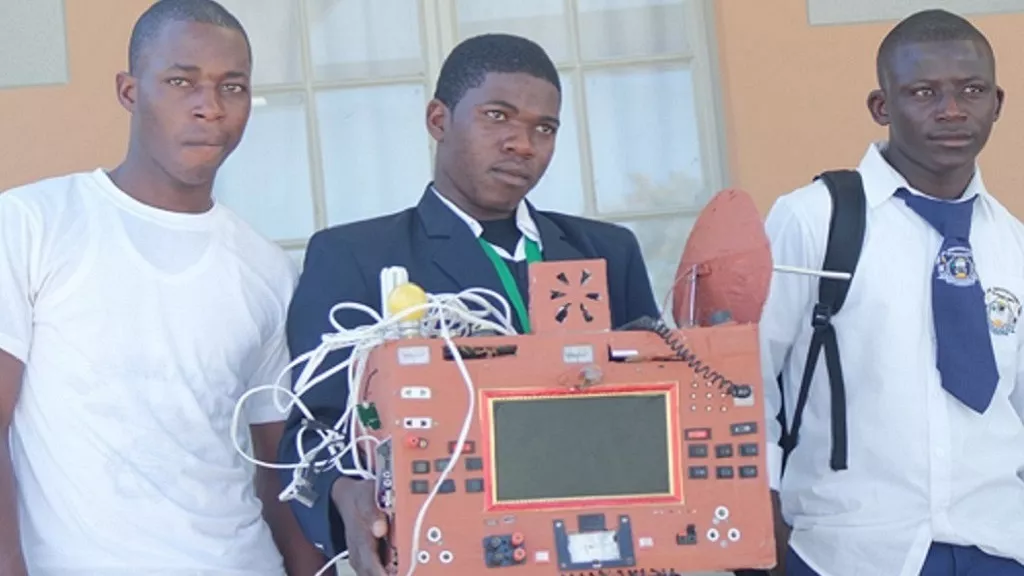
Petrus, then a Grade 12 learner at Abraham Iyambo Senior Secondary School in the Ohangwena Region, built the phone using scraps of old televisions and mobile phones. The device operated using radio frequencies, allowing users to make calls without interruption as long as they were within a radio frequency area. The project took two years to complete with financial help from his unemployed parents and a few community members.
Beyond its communication function, the invention was a multifunctional unit that included a built-in television set, radio, light bulb, fan, and sockets to charge other devices. It functioned off power supplied through a radiator.
Ad
Recognition and Early Promise
Petrus won first place at the Nampower National Science Fair for young innovators in 2016 for his creation. His achievement captured national and international media attention. He was described as a rising star and a genius, with many expecting the Namibian government to help him develop his invention.
The inventor received a three-year study sponsorship from Erongo Marine Enterprises, valued at N$135,000, to pursue a course in electronics at the Windhoek Vocational Training Centre. He enrolled in February 2018 with hopes of putting Namibia and the continent on the map with more ground-breaking inventions.
The Sam Nujoma Foundation also provided assistance. Petrus was attached to NamWater for 18 months after completing his studies.
From telephone and television parts, a Namibian high school student, Simon Petrus has invented a mobile phone that has an in-built television set, a radio, a light bulb, a fan, including sockets to charge other devices.
Setbacks and Unfulfilled Promises
Despite the early promise, the path for Petrus has been marked by obstacles. After he failed his Grade 12 examinations, a mobile operator reportedly withdrew a promised study sponsorship. The operator later said it was unaware of any formal agreement.
In 2018, Petrus was involved in a car accident that put him in a coma. He was rescued by the wife of an engineer, who helped him recover.
Despite completing his studies in 2023, Petrus has struggled to find employment in his field. He continues to work on the prototype, which he calls the "Simon Petrus Phone," but has not been able to find the support needed to bring it to market.
How the Phone Works
The device uses radio frequencies to transmit voice signals, functioning similarly to a walkie-talkie but designed to be used as a phone. It does not rely on telecommunications infrastructure, making it particularly valuable for remote and rural areas where cellular networks are unreliable or non-existent.
Petrus's parents, who were unemployed, raised over $2,000 to help fund his project. The device, which took two years to build, was constructed using recycled electronic components and a simple circuit.
Key Differences from a Standard Mobile Phone
Feature
Simon Petrus's Device
Standard Mobile Phone
Communication Method
Uses radio frequencies to transmit voice signals directly
Uses a cellular network with base stations and a complex infrastructure
SIM Card Requirement
No SIM card or cell tower needed
Requires a SIM card to connect to a specific mobile network
Coverage
Limited to the range of its radio frequency broadcast area, similar to a walkie-talkie
Works over vast distances through a network of interconnected towers
Functionality
A multifunctional unit built from recycled parts; included a phone, radio, TV, light bulb, fan and charging sockets
Primarily a communication device, with additional features driven by software
Target Application
Built to be useful in rural areas with poor or no network coverage
Designed for areas with established cellular infrastructure
Infrastructure Dependence
Completely independent of any existing mobile network
Fully dependent on mobile network operator infrastructure
The Walkie-Talkie Comparison
The comparison to a walkie-talkie is quite accurate for a few key reasons:
Radio Technology: The core of his invention is the use of radio frequencies for communication. This is the same fundamental technology used in walkie-talkies, which are essentially portable two-way radios.
Infrastructure Independence: Like a walkie-talkie, his phone operates without the need for a SIM card or a pre-existing cellular network.
Target Application: The device was built to be useful in rural areas with poor or no network coverage. This aligns perfectly with a walkie-talkie's purpose of providing communication in locations without a standard network.
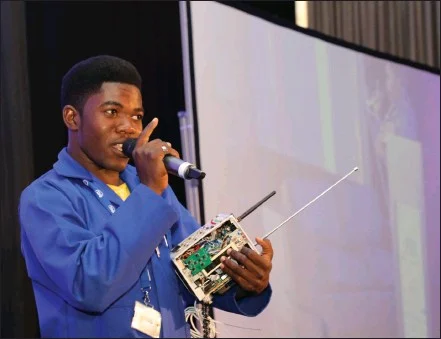
Simon Petrus explaining the functionalities of his SIM-free phone, highlighting its potential impact on communication in areas with limited infrastructure.
More Than a Walkie-Talkie
While its core communication method is analogous to a walkie-talkie, Petrus's invention is also much more. He essentially created a "Swiss Army knife" of electronics. He integrated a working radio, television, fan and power sockets into the same box built from old electronics. This is a crucial distinction—it was a portable power and entertainment station, not just a communication tool.
Why It Remained a Prototype
The device could not be commercialised due to a few significant hurdles:
Regulatory Issues: The Namibian Communications Regulatory Authority stated that the device needed to be properly licensed and registered, as its radio frequency could interfere with other critical communications.
Funding and Support: Despite early recognition, financial and institutional backing dried up, meaning he could not develop the prototype further.
Bureaucratic Obstacles: Petrus has expressed frustration, believing his invention was viewed as a threat to telecom operators.
"I am not happy with how my prototype was treated by the experts. I expected that this project would be implemented somewhere in the world. What is the point of submitting ideas to the nation if nothing is implemented?" he said in a 2022 interview.
The Bigger Picture
Petrus's story has become emblematic of a broader pattern: talented young African innovators struggling to get support for their ideas, even when they produce impactful prototypes. Years later, his device still exists only as a prototype, and he remains unemployed, continuing to work on improving the project.
The telecommunications industry may have seen his device as a threat, but for rural communities lacking connectivity, his invention represented a potential lifeline.
With reporting from New Era, The Namibia Economist, Zoomit, GameStar and various social media sources.
A Call to Action: What Readers Can Do
Simon Petrus's story is a powerful reminder that Africa is full of untapped genius. The continent's young innovators hold the solutions to many of our most pressing challenges. Yet, without support, these ideas remain unrealised.
The question is not whether Petrus has the talent. He has already demonstrated that. The question is whether we, as a continent, have the will to invest in our own innovators. If his device were to be further developed, it could be a breakthrough for connectivity in rural and remote communities across the continent, where network coverage is often limited or non-existent.
How to Help
Readers who are interested in seeing this project progress can reach out to the Namibian government, the African Union, or private investors to advocate for funding and support for Petrus's work. You can also share this article to raise awareness about the need to support African innovation.
If you are a potential investor, mentor, or development partner, consider reaching out to Simon Petrus directly through his social media channels or by contacting the Namibian Ministry of Higher Education, Technology and Innovation.
The continent does not need to import every solution. Sometimes, the solution is already here, waiting for someone to take it seriously. Petrus's phone is proof of that. The question now is: will we let this genius continue to go to waste, or will we help him build the future he has already imagined?
Please complete the verification below to continue.
Please complete the verification
Human verification passed
Edit Comment
Delete Comment
Are you sure you want to delete this comment?
This action cannot be undone.
Loading comment content...
We value your privacy
We use cookies to enhance your browsing experience, serve personalized content, and analyze our traffic. By clicking "Accept All", you consent to our use of cookies. You can manage your preferences at any time. Learn more.
Cookie Settings
We use cookies to improve your experience on our site. You can choose which cookies to allow. Read our full Cookie Policy.
Essential CookiesRequired
These cookies are necessary for the website to function properly and cannot be switched off.
Analytics & Performance
These cookies help us understand how visitors interact with our website by collecting anonymous information.
Functional Cookies
These cookies enable enhanced functionality and personalization, such as remembering your preferences.
Targeting & Advertising
These cookies may be used by advertising partners to build a profile of your interests and show you relevant ads.











Comments (0)
No comments yet. Be the first to share your thoughts!