Senegalese pharmacist Dr. Mouhamadou Sow, CEO of Teranga Pharma, has led his company to produce a generic version of hydroxyurea for the management of sickle cell disease, marking the first time the frontline treatment has been manufactured on African soil in a development expected to improve access to affordable medicine for millions of patients across the continent.
The treatment, branded DREPAF, is produced at Teranga Pharma's 9,000-square-metre factory in Mbao, on the outskirts of Dakar. Launched in November 2025, the drug is available in 500mg doses for adults and 100mg doses for children, with the stated aim of reducing painful sickle cell crises by threefold.
The achievement is particularly significant given the scale of the disease's impact. Africa accounts for nearly 80 percent (80%) of global sickle cell cases, yet the continent has historically depended on expensive medicines imported from Europe and the Americas. An estimated 300,000 to 400,000 babies are born each year in Africa with severe forms of sickle cell disease, and without early treatment, close to half of affected children do not survive to their tenth birthday.
Ad
A Long Overdue Correction
For years, patients who could not access or afford imported hydroxyurea simply had no local alternative. Dr. Mouhamadou Sow, who is both a physician and a pharmacist, explained the significance of the breakthrough:
"Africans do not have access to the active ingredient. So the first key point is that Teranga Pharma has enabled Senegalese and Africans to gain access to this molecule."
Before Drepaf, doctors often had to treat the consequences of the disease rather than its underlying cause. "Doctors often had to treat the consequences of the disease rather than addressing its root cause, the red blood cells," Sow told AFP.
The local production also addresses chronic supply shortages that have plagued the continent. A 2023 study published in the medical journal Blood found that 78 percent of healthcare professionals surveyed across 13 French-speaking sub-Saharan African countries reported frequent disruptions in hydroxyurea supplies.
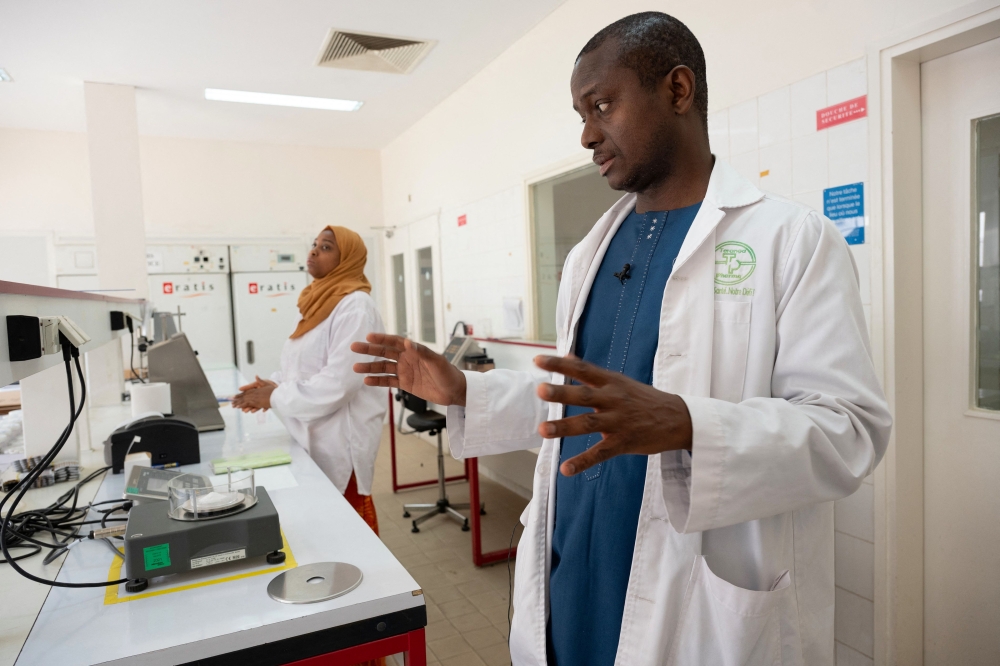
Senegalese pharmacist and Teranga Pharma CEO Dr. Mouhamadou Sow shows one of his laboratories in Mbao. Photo credit: SEYLLOU/AFP
Affordable Pricing and Regional Ambitions
The two versions of Drepaf are sold to pharmacies at wholesale prices of 3,000 and 1,500 CFA respectively, while imported hydroxyurea drugs already on the market cost up to three times as much. Drep.Afrique, the organisation partnering with Teranga Pharma on the project, says the medicine is supplied at cost, without a commercial margin, with the price estimated at about 50 to 100 CFA francs per day depending on the patient's age and dosage.
The initiative is backed by $7.1 million in funding and comes at a time when access to imported treatments has become increasingly difficult. Teranga Pharma is working with an Indian technical partner to ramp up production and supply other African nations. The company is already working with Burkina Faso, Guinea and Ivory Coast, and has received requests from the Democratic Republic of Congo, Gabon and Cameroon. Its longer-term objective is to meet demand across the entire sub-Saharan continent by 2030.
Real-World Impact
For patients like 18-year-old Mamadou Tahirou, the new treatment offers a glimmer of hope. Tahirou, who was diagnosed at age three, has endured bone pain, severe anaemia, extreme fatigue and intense headaches that frequently land him in hospital. His mother, Rabiatou Diallo, spoke of the difficulty of affording treatment: "He has pain in his feet, and at the moment he cannot walk. It is very difficult. The treatment and hospital costs are very expensive," she said.
Lala Dieng, whose 17-year-old son was diagnosed six years ago, has noticed a tangible improvement since switching to Drepaf. "Doctors used to prescribe Hydrea 500 to alleviate his episodes. He recently switched to Drepaf 100, and I've noticed he has far fewer attacks," she told AFP.
Drepaf represents a significant step forward in the care of children, said Magueye Ndiaye, president of the Senegalese Association for the Fight Against Sickle Cell Disease. "Until now, patients had to buy two boxes of 20 tablets. Now a single box of Drepaf, which contains 60, is enough and for the same price," he said.
A Step Towards Pharmaceutical Sovereignty
The development is part of a broader push across Africa to reduce dependence on imported medicines and build local pharmaceutical manufacturing capacity. The COVID-19 pandemic exposed the risks of relying on a small number of manufacturing centres outside Africa for critical medical products, intensifying calls for greater local production of vaccines, medicines and other health commodities.
Dr. Sow captured the larger ambition: "Our approach is based not only on financial considerations but also on public health. Because if Africa is to develop, if Africa is to enjoy good health, the treatment that Africans take must be produced in Africa."
With reporting from AFP, TRT Afrika, BusinessDay Nigeria, Pulse Nigeria, West Africa Weekly and African News Agency.
Please complete the verification below to continue.
Please complete the verification
Human verification passed
Edit Comment
Delete Comment
Are you sure you want to delete this comment?
This action cannot be undone.
Loading comment content...
We value your privacy
We use cookies to enhance your browsing experience, serve personalized content, and analyze our traffic. By clicking "Accept All", you consent to our use of cookies. You can manage your preferences at any time.
Cookie Settings
We use cookies to improve your experience on our site. You can choose which cookies to allow.
Essential CookiesRequired
These cookies are necessary for the website to function properly and cannot be switched off.
Analytics & Performance
These cookies help us understand how visitors interact with our website by collecting anonymous information.
Functional Cookies
These cookies enable enhanced functionality and personalization, such as remembering your preferences.
Targeting & Advertising
These cookies may be used by advertising partners to build a profile of your interests and show you relevant ads.











Comments (0)
No comments yet. Be the first to share your thoughts!