South Africa's 2026 Local Government Elections have produced a fractured political landscape, with the ruling African National Congress holding a narrow national lead over the Democratic Alliance while losing its grip on key metropolitan municipalities, setting the stage for complex coalition negotiations that will determine the governance of the country's major cities.
Preliminary results released by the Electoral Commission of South Africa on Thursday morning showed the ANC with approximately 31.76 percent of the national vote against the DA's 31.23 percent, with only about 15 percent of ballots counted at that stage. By midday, with roughly 30 percent counted, the ANC remained ahead nationally but had stumbled in critical metros, including Johannesburg where the DA held a substantial lead.
A National Picture of Decline
The results confirm a trend that began in 2021 and accelerated in the 2024 general elections. The ANC, which has governed South Africa since the end of apartheid in 1994, received less than half the national vote for the first time in the 2021 municipal elections and subsequently lost its parliamentary majority in 2024. The party's national support in these elections appears to be tracking at around 30 to 32 percent, a significant decline from the 45.59 percent it secured in 2021.
Ad
The DA, meanwhile, has consolidated its position as the leading opposition force. With nearly half the vote counted, the party stood at 26.33 percent nationally, up from 21.62 percent in the previous municipal elections. The uMkhonto weSizwe Party, contesting its first local government election, was in third place with 7.86 percent, leading in KwaZulu-Natal.
Metropolitan Battlegrounds
The most dramatic shifts are occurring in the country's major cities. In Johannesburg, with 21 percent of the vote counted, the DA led with 39.2 percent against the ANC's 17.6 percent, with ActionSA at 16.3 percent. In Tshwane, the DA held 32.5 percent against ActionSA's 23.3 percent and the ANC's 20.6 percent. In Ekurhuleni, the DA was at 37.4 percent while the ANC trailed at 18.7 percent.
Cape Town remained a DA stronghold with 60.7 percent of the vote counted. In Nelson Mandela Bay, the DA led with 42.3 percent against the ANC's 26.1 percent.
In KwaZulu-Natal's eThekwini metro, the MK Party dominated with 39.4 percent against the ANC's 23.6 percent and the DA's 23.2 percent, though only 2 percent of votes had been counted at that stage.
DA Celebrates Historic Gains
The DA moved quickly to claim victory in uMngeni Municipality in KwaZulu-Natal, where it secured more than 60 percent of the vote, up from 48 percent in 2021. The party also won five wards previously held by the ANC, including areas in Howick West, Lidgetton and Mpophomeni.
DA KwaZulu-Natal chairperson Dean Macpherson said the results demonstrated the party's growth across demographics. "In the four 100 percent black township wards in the municipality, the DA has won every single one of them with a commanding majority," he said.
The party also reported gains in the Eastern Cape, including an increased majority in Kouga Local Municipality and a position as the largest party in Nelson Mandela Bay with more than 40 percent of the vote.
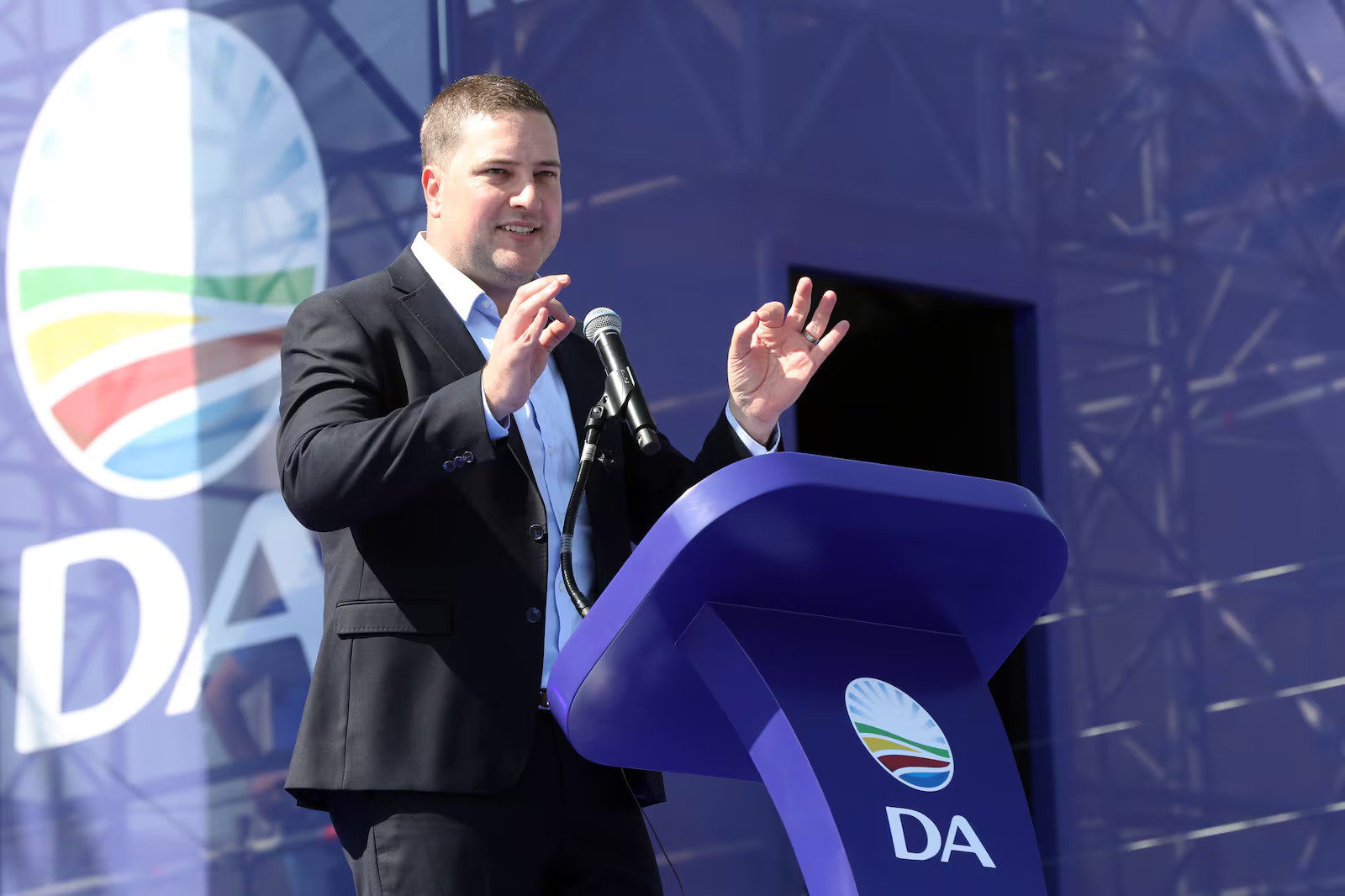
DA leader Geordin Hill-Lewis earlier projected a 59% of the vote in the City of Cape Town, drawing mixed reactions from rival parties. Picture: Sunday Times/Thapelo Morebudi
Coalition Negotiations Begin
With projections suggesting that more than 100 municipalities could be governed by coalitions, attention has shifted to the negotiations that will determine who holds power in hung councils. The ANC's Deputy Secretary-General Nomvula Mokonyane said the party was "open to talk to everyone and work with everyone" to ensure stability, though she dismissed rumors of specific deals with the DA as "gossip."
Both the ANC and DA are reportedly centralising negotiations at their head offices rather than leaving them to provincial structures, allowing them to trade positions across councils and embed their electoral values in final agreements. For the ANC, this will be difficult given regional power blocs that have asserted their independence during candidate selection processes.
ActionSA, which has emerged as a potential kingmaker in several metros, indicated it would negotiate without "red lines" but would insist on clear principles and accountability. The party's national chairperson Michael Beaumont leads its negotiations, taking direction from party president Herman Mashaba.
The Patriotic Alliance, led by Gayton McKenzie, is another key player in the coalition scramble. The party has positioned itself as a willing partner in exchange for influence over portfolios with significant tender budgets.
A Verdict on Service Delivery
The elections were widely viewed as a referendum on the ANC's performance, particularly regarding service delivery failures in water and electricity provision. The party's decline has been attributed to corruption scandals, economic and security problems and poor management of municipalities, especially deficiencies in basic services.
Stellenbosch University research fellow Dr Lungelwa Kaywood warned that coalition agreements alone would not ensure stability. "As a country, we have spent five years treating coalition instability as a political problem when in my view it's largely a governance design problem," she said, noting that the Municipal Structures Amendment Bill that could limit motions of no confidence would not be in force for these elections.
Research by the Mapungubwe Institute for Strategic Reflection found that 80 of the country's 213 directly elected municipal councils had been hung at some point since the 2021 elections, with 74 municipalities being governed by coalitions or minority administrations by February 2026. Minority governments collapsed at roughly three times the rate of majority coalitions.
What Comes Next
The Electoral Commission has until the weekend to declare final results, after which coalition negotiations will intensify. The outcome will shape the political landscape ahead of the 2029 national elections and determine whether the ANC's "renewal" strategy can reverse its declining fortunes.
For voters in the major metros, the immediate question is whether the coalitions that emerge will deliver the stability and services that the previous administration failed to provide. The DA's gains in uMngeni offer one model: a party that took control from the ANC and, according to its supporters, demonstrated that an alternative was possible. Whether that model can be replicated at scale in Johannesburg, Tshwane and Ekurhuleni will depend on the deals struck in the coming days.
With reporting from Daily Maverick, Democratic Alliance, GroundUp, Infobae, Mail & Guardian, The National, The Witness and Xinhua.
Please complete the verification below to continue.
Please complete the verification
Human verification passed
Edit Comment
Delete Comment
Are you sure you want to delete this comment?
This action cannot be undone.
Loading comment content...
We value your privacy
We use cookies to enhance your browsing experience, serve personalized content, and analyze our traffic. By clicking "Accept All", you consent to our use of cookies. You can manage your preferences at any time. Learn more.
Cookie Settings
We use cookies to improve your experience on our site. You can choose which cookies to allow. Read our full Cookie Policy.
Essential CookiesRequired
These cookies are necessary for the website to function properly and cannot be switched off.
Analytics & Performance
These cookies help us understand how visitors interact with our website by collecting anonymous information.
Functional Cookies
These cookies enable enhanced functionality and personalization, such as remembering your preferences.
Targeting & Advertising
These cookies may be used by advertising partners to build a profile of your interests and show you relevant ads.












Comments (1)