The Shakahola massacre was a horrific tragedy where a religious preacher Paul Mackenzie caused over 429 people to starve to death. Mackenzie told his followers to stop eating and starve themselves. He claimed this would help them "meet Jesus" before the end of the world.
Most countries in Africa legally establish that freedom of religion is a right conferred to all individuals, with several nations having anti-discrimination laws which prohibit religious discrimination. Several countries, particularly in West Africa and Southern Africa, have a high degree of religious tolerance, both as enforced by the government and as reflected by societal attitudes.
Constitutional Protections Across the Continent
Across Africa, constitutions define the rights and freedom of worship. In Kenya, Article 8 of the Constitution declares no state religion, while Article 32 protects every person's right to choose, manifest and practice any religion or belief in public or private. In South Africa, Section 15 of the Constitution guarantees freedom of religion, belief and opinion for all citizens, balancing community practices with a strict non-establishment framework. In Nigeria, Section 38 of the Constitution of the Federal Republic of Nigeria entitles every person to freedom of thought, conscience and religion, including the freedom to change beliefs and manifest them in worship or teaching. Botswana's Constitution provides broad fundamental rights and freedoms of conscience and worship without establishing a state religion.
Ad
States with Official or Preferred Religions
North and Horn of Africa countries such as Algeria, Tunisia and Morocco often declare Islam as the state religion while simultaneously containing provisions guaranteeing the basic "freedom of worship" for citizens, though implementation is frequently regulated or restricted by state laws. In Somalia, Article 2 of the Provisional Constitution states that Islam is the state religion, and while it guarantees basic principles of religious freedom, societal and legal pressures heavily favor Sunni Islam.
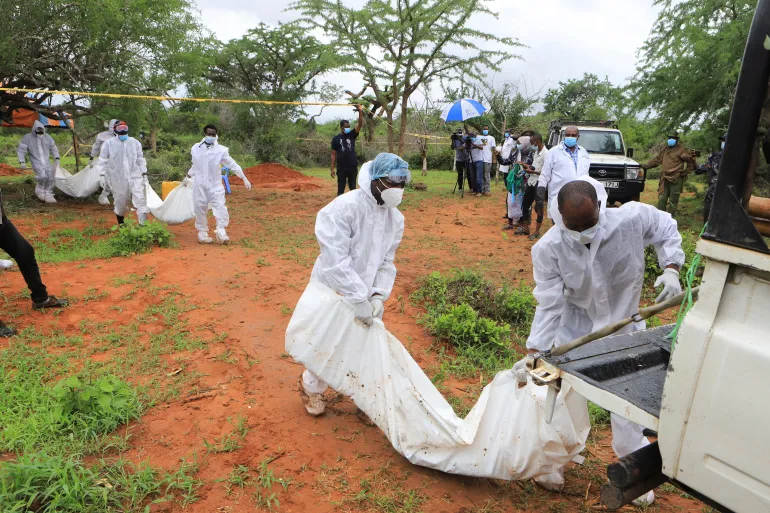
Forensic experts and homicide detectives carry the bodies of suspected members of a Christian cult exhumed from graves in Shakahola Forest in Kenya
Varieties of Religious Extremism in Africa
Religions most commonly practiced in Africa can, broadly speaking, be subdivided into Muslim, Christian and African traditional religions, with distinct and influential Jewish, Hindu and Buddhist communities also present.
Though most African nation's constitutions dictate rights and freedom of worship, some lack legal frameworks to govern and closely monitor the practices from various religious groups. This has led to the evolution of religion to radicalization and extremism. Several nations have historical or recent tragedies involving deadly religious manipulation, apocalyptic sects and mass deaths, with a lack of accountability by the concerned religious leaders and governments.
Kenya: The Shakahola Massacre
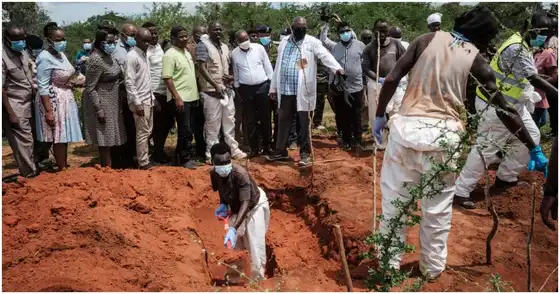
The most catastrophic religious extremist group in recent Kenyan history is the Good News International Church, led by self-proclaimed pastor Paul Nthenge Mackenzie. The Shakahola massacre, uncovered in early 2023, exposed how vulnerable populations can be manipulated under the guise of religious salvation. Mackenzie told his followers to stop eating and starve themselves, claiming this would help them "meet Jesus" before the end of the world. More than 429 bodies, including many children, were found buried in shallow mass graves in the forest.
Uganda: The Kanungu Cult Massacre
The Kanungu Cult Massacre occurred in Uganda in March 2000. The Movement for the Restoration of the Ten Commandments of God, led by Credonia Mwerinde and Joseph Kibwetere, preached that the world would end on December 31, 1999. On March 17, 2000, over 500 followers were locked inside a boarded-up church in Kanungu, which was then doused in fuel and set on fire. Subsequent police investigations uncovered hundreds of additional bodies buried in shallow mass graves at properties linked to the cult across Uganda. The total death toll reached 778 victims, making it one of the largest cult-related mass killings in global history.
Nigeria: A Pattern of Confinement and Violence
Nigeria has experienced multiple incidents involving extreme religious confinement, forced isolation and fatal rituals. In June 2022, Nigerian authorities raided a church basement in Ondo State where they rescued 77 people, including 26 children. The pastor had indoctrinated them into believing the second coming of Christ was imminent and ordered them to abandon school, work and family to stay confined within the church premises.
The Maitatsine Riots, led by Muhammadu Marwa (Maitatsine) in northern Nigeria, isolated its followers from mainstream society, rejected modern technology and education, and eventually launched violent uprisings that resulted in the deaths of over 4,000 people.
Democratic Republic of the Congo: Bundu dia Kongo
While primarily political-religious, the DRC has seen massive loss of life linked to spiritual leaders demanding complete obedience and isolation. Bundu dia Kongo is a secessionist religious sect that mixes Christian elements with traditional African spirituality.
The Challenge of Religious Extremism
From Boko Haram in Nigeria to Al-Qaeda and ISIS in the Middle East, religious extremism is often associated with Islam in both local and international discourse. The violent expressions of insurgent ideology have shaped policy and public perception of what extremism is for many decades. However, religious extremism is a concept that manifests across religions over time and often operates under the radar.
Inside the Attempt to Regulate Religious Institutions
In response to past tragedies, many countries are introducing or enforcing stricter laws to regulate religious organizations, aiming to curb exploitation, radicalization and unregistered operations.
Burkina Faso
The transitional assembly adopted a comprehensive religious freedom and organization bill requiring all religious leaders to obtain state-approved certification through a new national supervisory body. This law mandates membership in state-recognized umbrella groups, bans public officials from preaching on duty and criminalizes religious hate speech, though it has faced local pushback and protests from some religious figures.
Mozambique
Mozambique has also discussed a draft Law on Religious Freedom and Worship to curb excesses and discipline improper behavior among certain denominations. The proposed legislation plans to formally register religious activities, impose taxes and require a minimum baseline of 200 signatures for a religious group to gain legal recognition.
East Africa: Rwanda and Kenya
East African member states have shown a lot of interest in regulating religious groups, with Rwanda and Kenya being on the front bench.
Rwanda implemented a strict law in 2018 requiring religious leaders to hold mandatory theological degrees and forcing places of worship to meet specific building, safety and soundproofing standards. The Rwandan Governance Board has actively enforced these rules, inspecting thousands of locations and shutting down over 7,000 non-compliant churches and mosques for failing to meet infrastructure and registration guidelines.
Kenya introduced the Religious Regulations Bill (2024) following the Shakahola massacre to curb such extremism. The bill establishes a dedicated registry to issue, suspend or revoke the registration of religious organizations and leaders; mandates that a religious body must have a minimum number of members (proposed as 25 to 50), a physical address, a doctrinal constitution and proof of affiliation with a registered umbrella organization; requires religious leaders to possess certified training from recognized theological institutions; and compels religious bodies to maintain separate bank accounts for tithes and offerings versus income generated from commercial or non-charitable economic activities. Failure to comply attracts severe penalties, including fines up to KSh 5 million or prison sentences up to 3 years for operating unregistered entities, and fines up to KSh 1 million or 2-year sentences for failing to comply with financial segregation rules.
Opposition to the Kenyan Bill
Various umbrellas of religious bodies have issued statements calling for the termination of the bill, citing that it may halt their operations. According to them, passing such bills into law may violate the freedom of worship and gives the state too much power over faith.
Critics also argue that the tough education and registration rules will shut down small, rural or indigenous churches due to impractical and punitive rules in terms of unfair penalties and unrealistic demands. Clerics also feel that the government could use registration and oversight powers to target, silence or suppress specific denominations and viewpoints.
Can Religious Regulation Laws Save African Nations from Extremism?
Although many countries have tried introducing religious regulation laws, these laws alone cannot save them from extremism. Legal frameworks present a complex double-edged sword: while little regulation can leave an open vacuum for radicalization to flourish, excessive state control often fuels the very grievances that drive extremist recruitment. However, they serve as a critical administrative tool when combined with broader socio-economic, political and security strategies.
While state oversight can prevent radicalization from festering in unregulated spaces, heavy-handed crackdowns risk driving extremist groups underground, stoking grievances and infringing upon fundamental human rights. Research and recent security policy analyses show that while regulation can provide tools to flag financial anomalies and overt hate speech, effective counter-extremism requires balancing legal enforcement with socio-economic development and community engagement.
Religion is rarely the sole driver of extremism; laws do not fix the structural poverty, high unemployment or political marginalization that makes radical recruitment appealing. Treating religious expression strictly as a security threat can alienate peaceful communities and fuel a narrative of state-sponsored oppression—another shortfall of such laws and regulations.
A Call to Action
The most effective approach to combat religious fanaticism is through a combination of education, interfaith dialogue and community engagement. By empowering individuals through education, they can become less susceptible to harmful practices and beliefs. Additionally, interfaith dialogue promotes understanding and respect for different religious views, which can reduce conflicts between religious groups. Engaging with the community can also play a crucial role in fostering mutual respect and tolerance among individuals of different faiths.
Please complete the verification below to continue.
Please complete the verification
Human verification passed
Edit Comment
Delete Comment
Are you sure you want to delete this comment?
This action cannot be undone.
Loading comment content...
We value your privacy
We use cookies to enhance your browsing experience, serve personalized content, and analyze our traffic. By clicking "Accept All", you consent to our use of cookies. You can manage your preferences at any time. Learn more.
Cookie Settings
We use cookies to improve your experience on our site. You can choose which cookies to allow. Read our full Cookie Policy.
Essential CookiesRequired
These cookies are necessary for the website to function properly and cannot be switched off.
Analytics & Performance
These cookies help us understand how visitors interact with our website by collecting anonymous information.
Functional Cookies
These cookies enable enhanced functionality and personalization, such as remembering your preferences.
Targeting & Advertising
These cookies may be used by advertising partners to build a profile of your interests and show you relevant ads.


















Comments (0)
No comments yet. Be the first to share your thoughts!