


On July 25, 2024, what began as a protest against taxes became a defining moment in Kenya's modern history. Parliament was breached, the bill was eventually withdrawn, and at least 60 people were killed during the protests, according to human-rights groups. Two years later, families are still asking who killed their children, whether justice will ever come and whether the independence Kenya won in 1963 truly delivered the freedom its people were promised.
The Protest That Changed Kenya
The 2024 protests began with a simple message: Reject the Finance Bill. But beneath the anger over proposed taxes was a deeper frustration. Young Kenyans were struggling with unemployment, high living costs and a lack of opportunities. Many felt that they were being asked to sacrifice more while those in power remained protected from the hardships faced by ordinary citizens.

On June 25, protesters entered Parliament after police fired at demonstrators outside the building. The confrontation turned deadly. The Kenya National Commission on Human Rights later reported at least 60 deaths connected to the protests between June and July 2024. Amnesty International and other rights organizations documented similar concerns over the use of excessive and lethal force.
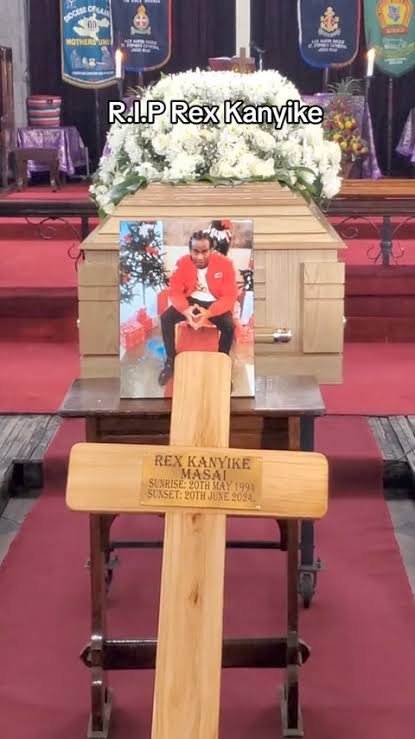
Among those killed was Rex Kanyike Masai, a 29-year-old whose death became one of the defining images of the protests. For his family, the demonstrations were not about politics anymore; they were about a son who had left home and never returned.

The Government's Response
As the protests escalated, President William Ruto condemned the violence and said the demonstrations had been hijacked by criminals. In a televised address on June 25, 2024, he described the events as "treasonous" and said security was his government's "utmost priority." The government later maintained that some protesters had been infiltrated by criminal and political groups, pointing to looting, destruction of property and the attack on Parliament.
But the government also acknowledged that security officers who acted outside the law would face legal action. A Cabinet statement in July 2024 said officers who violated the law would be dealt with through the institutions mandated to do so.
The protests eventually forced a major political reversal. On June 26, President Ruto announced that he would not sign the Finance Bill, saying he had listened to Kenyans and would withdraw it. The protesters had won their immediate demand, but many had paid for that victory with their lives.

The Families Left Behind
For the families, the withdrawal of the Finance Bill could never bring their children back. Rex Masai's mother, Gillian Munyao, became one of the strongest voices demanding accountability. Her message to the government was direct: "Arrest the killer cops, that's my message to the government." For her, justice was not a political argument; it was a mother asking why her son had been killed.
Some families have spent two years searching for answers. Others have struggled to locate relatives who disappeared during the unrest. In June 2026, families returned to the streets to remember those killed in 2024. Many said they were still waiting for compensation and meaningful accountability.


The Kware Horror: Bodies in a Nairobi Estate
As Kenya was still reeling from the protest deaths, another horror emerged in Nairobi. In July 2024, bodies were discovered in a quarry in Mukuru Kwa Njenga, sending shockwaves through the community. The remains of several women were recovered, some reportedly showing signs of mutilation. The discovery was particularly disturbing because the site was close to a police station.
The Independent Policing Oversight Authority investigated possible police involvement, while authorities arrested a man they identified as Collins Jumaisi Khalusha and accused him of being responsible for multiple killings. But for families, the investigation did not erase the horror; all they wanted was to know how their loved ones ended up dead and dumped in a place where people lived, worked and walked every day.
The case became another painful reminder of the vulnerability of ordinary Kenyans—and of the questions that arise when institutions responsible for protecting citizens are themselves placed under scrutiny. Years later, concerns remained over the transparency and conclusion of investigations surrounding the bodies. Human Rights Watch called for the authorities to release the findings of their inquiry. For the families, the question was painfully simple: Who will answer for the dead?

Did They Get Justice?
This is where the story becomes uncomfortable. For many families, the answer is still no. There have been investigations, official statements and promises of compensation. But families and rights groups say accountability has been slow.
By June 2026, only a fraction of families had received reparations, according to reporting by the Associated Press. Three police officers had been charged over killings connected to the 2024 protests, but families continued to demand broader accountability. The government has now set aside KSh2 billion for compensation linked to human-rights violations during protests between 2017 and 2025.

President Ruto acknowledged the suffering of victims, saying: "The KSh2 billion we have committed cannot replace a son or a daughter." He also said the country must pursue justice and learn from the violence. But compensation and justice are not necessarily the same thing. Money may help a family survive, but it cannot answer the question of who pulled the trigger.
The Cycle Did Not End in 2024
The anger that filled Kenya's streets in 2024 did not disappear. In 2025, protests erupted again following the death of blogger and teacher Albert Ojwang in police custody. Ojwang had been arrested in connection with an online post.

His death triggered another wave of demonstrations and renewed accusations of police brutality. His family said his body showed signs of physical trauma, while human-rights organisations demanded an independent investigation.
The protests once again brought young Kenyans face-to-face with police. Once again there were deaths, injuries and arrests. Again the question was raised: How many Kenyans must die before accountability becomes more than a promise?

Behind the statistics are ordinary lives: a graduate with a university certificate but no job, a young man surviving on casual work, a mother struggling to pay rent, a young Kenyan who joins a demonstration because they see no other way to make their voice heard. They are fighting for a future they cannot see. And yet, when they walk into the streets, another thought follows them: Will I return home alive?

The Ebola Controversy
The struggle over who makes decisions in Kenya has also appeared outside the streets. In 2026, controversy erupted over a U.S.-backed Ebola quarantine facility planned at a military base near Nanyuki. The arrangement was linked to plans to quarantine U.S. nationals who had been exposed to Ebola in the Democratic Republic of Congo. The idea was that people who had been exposed but were not necessarily sick would be brought to Kenya and monitored for the virus during the incubation period.
The government defended the arrangement as part of health cooperation and preparedness. But residents, activists and some health professionals questioned the decision, asking why Kenya should host such a facility and whether the country had been adequately consulted. Protests followed in Nanyuki, and two people were reported killed during unrest surrounding the project.
The controversy eventually moved to court, where Kenya's High Court suspended the agreement and ordered a halt to the establishment of the facility. But the story did not end there. Reports later said the facility was operating despite the court order, with seven American aid workers reportedly being quarantined in military tents for 21 days. Activists accused the government of disregarding the court's orders. Kenya's Health Minister Aden Duale subsequently said he had ordered an immediate halt to construction after being found in contempt of court.
The episode left Kenyans with another uncomfortable question: When decisions are made in their name, how much say should ordinary citizens have? The Ebola controversy was not simply about the virus; it became another test of transparency, sovereignty and public trust. That is perhaps the cruelest irony. The people demanding a better Kenya are sometimes afraid of the institutions that are supposed to protect them.

The Irony of Uhuru
Kenya's independence was supposed to change the relationship between the citizen and the state. Colonial rule had used detention, violence and repression to silence resistance. After independence, the Kenyan police were supposed to become protectors of an independent people. Yet decades later, accusations of excessive force, unlawful killings and disappearances continue to haunt the country. The problem is therefore bigger than one protest or one government; it is about what happens when institutions created to protect citizens become institutions citizens fear.

A Country Still Asking What Freedom Means
Kenya is independent. Its flag is Kenyan. Its government is Kenyan. Its leaders are Kenyan. But perhaps independence cannot simply be measured by who sits in State House. True independence is also about whether an ordinary citizen can question the government without fear. It is about whether a young person can demonstrate peacefully and return home safely. It is about whether a mother who loses her child can receive justice. It is about whether a government can hear criticism without treating its citizens as enemies. And it is about whether the unemployed young Kenyan on the streets believes tomorrow will be better than today.

More than six decades after Uhuru, Kenya has achieved political independence. But for the families still waiting for justice, and for a generation still fighting for a future, the struggle for freedom feels unfinished. The question is no longer simply whether Kenya was liberated from colonial rule. It is whether every Kenyan has truly been liberated from fear because Uhuru was never supposed to mean freedom from white rulers alone; it was supposed to mean freedom for Kenyans.






Comments (0)
No comments yet. Be the first to share your thoughts!