


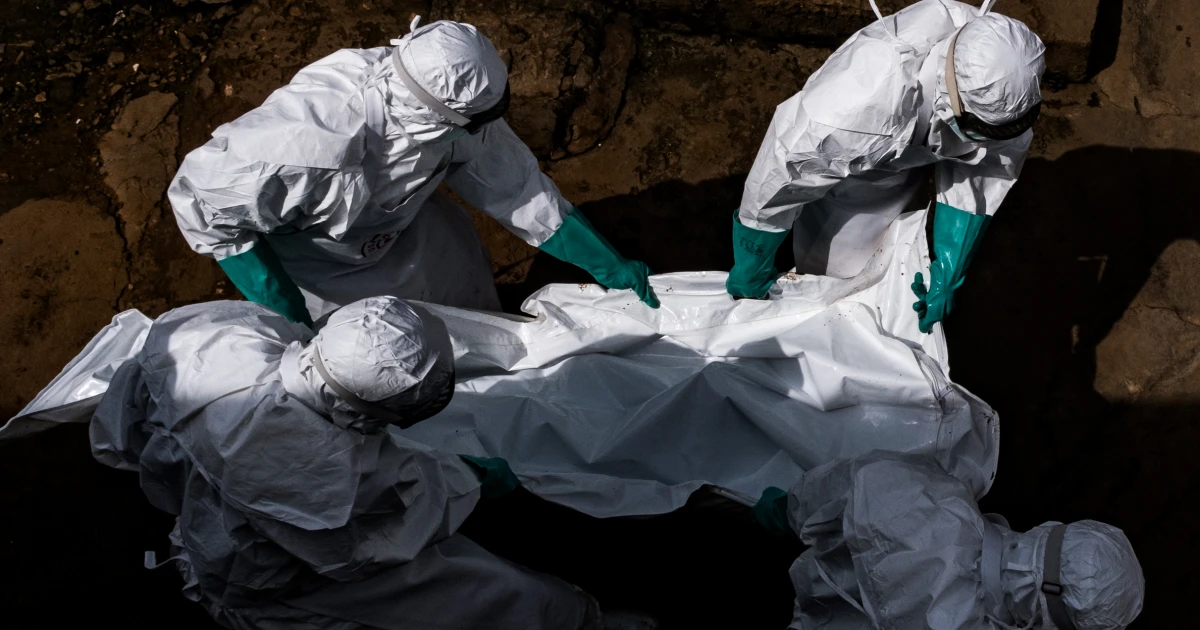
According to the National Public Health Institute, 79 new cases were recorded on Sunday alone in the northeastern provinces of Ituri and Kivu. The outbreak, caused by the Bundibugyo strain of the Ebola virus, was officially declared on May 15 and has now spread across five provinces: Ituri, North Kivu, South Kivu, Haut-Uele and Tshopo.

A Crisis Moving Faster Than Any Previous Outbreak
The World Health Organization has warned that the outbreak is outpacing response efforts despite significant gains in surveillance, treatment and research . WHO Director-General Tedros Adhanom Ghebreyesus told reporters in Geneva that the outbreak has expanded faster than any previous Ebola epidemic.
"Despite the progress we have made, the Ebola outbreak in DRC is continuing to outpace the response," Tedros said, noting that a treatment centre in Ituri province—the epicentre of the outbreak—was attacked earlier this week.
By comparison, the major Ebola outbreak in DRC in 2018-2020 "took more than 10 months to reach 2,000 confirmed cases". The current outbreak reached that milestone in just over two months.
Ituri province remains the epicentre, accounting for nearly 90 per cent of all confirmed infections . The health zones of Bunia, Mongbwalu, and Rwampara are the primary transmission hubs, collectively accounting for nearly 65 per cent of all confirmed cases nationwide.
The Challenge of Undetected Transmission
More than 80 per cent of newly detected cases are not linked to known contact lists, indicating that significant transmission chains remain undetected. Roughly two-thirds of deaths occur in communities before patients reach health facilities, meaning people are dying without ever receiving care.
The response is operating with substantially greater capacity than at the start of the outbreak, with:
- 16 laboratories functioning across affected areas
- 22 Ebola treatment centres and seven transit centres with more than 800 beds
- 11,435 contacts registered for follow-up, of whom 67.4 per cent had been seen
However, treatment facilities in North Kivu are operating at critical saturation levels. A total of 114 health workers have been infected in the DRC, with 36 deaths.
Displacement Camps: A Breeding Ground for Transmission
The United Nations has warned of the risk of Ebola spreading in camps for internally displaced persons in eastern DRC, stressing that overcrowding and limited access to basic services increase the risk of transmission. Confirmed cases have been recorded in at least 16 IDP camps in Ituri province, which house more than 270,000 people.
In Kigonze, a displacement camp on the outskirts of Bunia housing between 18,000 and 20,000 people, Ebola-related warnings are impossible to miss . Plastic handwashing stations dot the narrow paths between shelters, and health workers move briskly among newly built treatment facilities. Yet the living conditions make prevention extraordinarily difficult.
"There is a lack of medicines, a lack of water. It has already been four years since we received any assistance," said Sijudose Etienne, president of the Kigonze displacement site.
In Kigonze, about 45 people have died in the camp since May, with 20 of those deaths confirmed to have been caused by Ebola. Overcrowded shelters, chronic water shortages, damaged latrines, and limited healthcare access have created conditions where disease can spread quickly.
No Approved Vaccine, But Clinical Trials Underway
The current outbreak is caused by the rare Bundibugyo species of Ebola, for which there is no approved vaccine or specific treatment. However, clinical trials are now underway.
On July 2, trials began for two potential treatments—the monoclonal antibody MBP134 and the antiviral drug remdesivir—at the CME Ebola treatment center in Rwampara health zone, the outbreak's epicentre. A safety trial for the ChAdOx1 vaccine, led by the University of Oxford, began on July 13. A trial of the antiviral obeldesivir also began to test its effectiveness as post-exposure prophylaxis for people who have come in contact with confirmed cases.
Despite the absence of approved vaccines and treatments, 377 people have recovered in the DRC, "showing that with early diagnosis and safe care, this disease can be survived and stopped," Tedros noted.
Regional Spread and Cross-Border Concerns
The outbreak has spread to neighbouring Uganda, which has reported 20 confirmed cases, including 17 recoveries and two deaths. Uganda is approaching the conditions required to declare the outbreak over, subject to the completion of the prescribed surveillance period.
A first confirmed case reported in the border health zone of Mahagi has heightened concerns over potential cross-border transmission into Uganda. Under a Memorandum of Understanding signed by the two countries, Uganda is providing direct support to the DRC through deployed teams and shared expertise in cross-border surveillance, laboratory services, case management, investigations and community engagement.
A Funding Shortfall
The WHO and the African Centres for Disease Control have put forward a joint plan to address the outbreak, but there remains "a shortfall of more than $400 million". The DRC government and Africa CDC have called on partners and donors to release pledged resources rapidly and sustain operations in the most affected areas.
The outbreak has entered a decisive phase. The tools, institutions and regional expertise are in place. The challenge now is to make that capacity reach every affected community quickly enough to save lives and break transmission.
With additional reporting from Africa CDC, WHO, UN OCHA, and QNA.








Comments (0)
No comments yet. Be the first to share your thoughts!