A new report argues that productive investment could help African countries reduce their debt burdens, but the strategy also raises concerns about whether borrowing to finance economic growth could leave governments trapped in a cycle of debt repayments and renewed borrowing.
African countries could reduce their debt burdens by investing in projects that expand economic production, create employment and generate government revenue, according to a new report by the African Union Commission (AUC) and the Organisation for Economic Co-operation and Development (OECD).
However, the proposed strategy also raises an important question: could borrowing more money to address Africa’s debt crisis ultimately deepen the continent’s dependence on debt?
Ad
The report, Africa’s Development Dynamics 2026: Managing Debt for Transformation, argues that governments can improve their debt sustainability by directing borrowed funds towards productive investments that generate economic returns.
The organisations estimate that an additional $93 billion in public capital investment over five years could generate approximately $178 billion in additional economic output, create between 13.6 million and 22.6 million jobs and leave Africa’s debt-to-GDP ratio around 14 percentage points lower than it would otherwise be.
The report also estimates that the investment could reduce future debt accumulation by $557 billion.
While the projections suggest that productive investment could strengthen African economies, the strategy depends heavily on governments being able to generate sufficient economic returns from the projects they finance.
For countries already struggling with high debt repayments, the consequences of borrowing for projects that fail to deliver the expected returns could be significant.
Rather than resolving the debt crisis, additional borrowing could leave governments with larger financial obligations, limited fiscal space and a continued need to borrow to meet existing commitments.
Africa’s Debt Crisis and the Search for a Solution
African governments have increasingly relied on borrowing to finance infrastructure, public services and economic development.
However, rising interest rates, currency depreciation and growing debt repayments have placed significant pressure on public finances across the continent.
According to the AUC and OECD, Africa’s debt-to-GDP ratio reached 62% in 2025.
The report also highlights the increasing share of government revenue being used to service debt.
Between 2010 and 2024, interest payments increased from 9% to 25% of government revenues across African countries.
External debt servicing also rose from 4% to 19% of government revenues over the same period.
These figures highlight the growing difficulty many governments face in balancing debt repayments with spending on healthcare, education, infrastructure and other development priorities.
The report identifies 23 of the 38 African countries assessed by the International Monetary Fund and World Bank as being at risk of debt distress.
For these countries, the challenge is not simply finding additional financing.
It is ensuring that existing and future borrowing does not create financial obligations that become increasingly difficult to manage.
Could Borrowing More Money Become a Permanent Solution to Africa’s Debt Problem?
The central argument of the AU–OECD report is that borrowing can improve debt sustainability when the money is invested in projects that generate sufficient economic returns.
However, this approach also creates a risk that African governments could become increasingly dependent on borrowing to sustain economic growth.
When governments borrow to finance infrastructure or industrial development, they must repay the principal and interest regardless of whether the project delivers the expected economic benefits.
A railway, power station or industrial development project may take years to become operational.
During that period, governments may need to continue servicing the debt while waiting for the investment to generate economic returns.
If the project underperforms, the government may face a difficult choice between reducing spending on essential services, increasing taxes or borrowing additional money to meet its obligations.
This could create a cycle in which governments borrow to finance development, borrow again to service previous debt and continue borrowing because the economy has not generated sufficient revenue to reduce its dependence on external financing.
The risk is particularly significant for countries that borrow in foreign currencies but generate most of their revenue in local currencies.
If the domestic currency weakens, the cost of repaying foreign-currency debt increases, even when the underlying investment continues to operate.
In such circumstances, economic growth alone may not be enough to prevent debt from becoming increasingly difficult to manage.
African countries could reduce their long-term debt burdens by borrowing more to finance investments that drive economic growth, create jobs and increase government revenue, according to a joint report by the Organisation for Economic Co-operation and Development (OECD) and the African Union (AU).
The Difference Between Productive Investment and Sustainable Borrowing
The report makes an important distinction between borrowing for productive investment and borrowing that does not generate sufficient economic value.
However, the term "productive investment" does not automatically mean that a project will be financially sustainable.
A project may contribute to economic growth without generating enough direct revenue to repay the debt used to finance it.
For example, a new road may improve trade and reduce transport costs for businesses, but it may not generate sufficient toll revenue to cover its construction and financing costs.
Similarly, a power station may expand electricity supply and support industrial development, but its financial performance could be affected by electricity prices, operating costs and the ability of customers to pay.
The economic benefits of such projects may be substantial, but governments still need to meet their debt obligations.
This creates a potential mismatch between the time required for investments to generate wider economic benefits and the time available to repay the borrowing used to finance them.
The challenge for African governments is therefore not simply to identify projects that support economic development.
They must also determine whether the expected returns are sufficient to justify the cost, risks and repayment conditions of the borrowing.
Without this distinction, governments could continue accumulating debt under the assumption that economic growth will eventually resolve their financial difficulties.
The $93 Billion Investment Proposal: Opportunity or Additional Risk?
The AUC and OECD estimate that an additional $93 billion in public capital investment over five years could generate approximately $178 billion in additional economic output.
The report also projects between 13.6 million and 22.6 million additional jobs and a reduction of approximately $557 billion in future debt accumulation.
These projections suggest that productive investment could deliver substantial economic benefits.
However, they also raise questions about the assumptions underpinning the proposed strategy.
The projected outcomes depend on investments being implemented effectively, generating the expected economic returns and supporting government revenue.
If projects experience delays, cost overruns or lower-than-expected demand, the financial benefits could be significantly reduced.
Governments may also face additional costs associated with maintenance, operation and the eventual replacement of infrastructure.
The report's projections should therefore be understood as potential outcomes under its economic modelling, rather than guaranteed savings for every African country.
For governments already facing debt distress, the consequences of failing to achieve the expected returns could be severe.
The initial borrowing would remain, even if the anticipated economic growth did not materialise.
This raises the possibility that the proposed investment strategy could increase financial pressure on some countries before the expected benefits become available.
Africa’s Borrowing Costs Remain a Major Concern
One of the central challenges facing African governments is the cost of obtaining financing.
Countries that borrow at relatively high interest rates need to generate stronger economic returns to ensure that investments remain financially sustainable.
If borrowing costs exceed the returns generated by a project, the investment may increase rather than reduce the government's debt burden.
Currency depreciation can make the situation even more difficult.
The AUC and OECD estimate that a depreciation of 15% to 20% over two years could increase the debt-to-GDP ratio by approximately 12 percentage points over five years.
This highlights the risks associated with financing long-term development projects through foreign-currency borrowing.
A government may successfully complete an infrastructure project and improve economic activity, but a significant depreciation of its currency could still increase the domestic cost of repaying the debt.
For countries that depend heavily on commodity exports, fluctuations in global prices can create additional uncertainty.
A decline in export revenues may reduce the availability of foreign currency needed to service external debt.
These risks suggest that productive investment cannot be considered separately from the broader financial conditions under which governments borrow.
Infrastructure Development and the Risk of Underperforming Projects
Infrastructure is central to the AU–OECD strategy because investments in transport, energy and digital connectivity can support economic growth.
However, infrastructure projects can also create substantial financial risks when their costs and expected returns are not properly assessed.
Kenya's Chinese-funded standard gauge railway illustrates some of these challenges.
The railway was developed to improve transport connectivity and support economic activity, but its financial performance and repayment obligations have attracted significant scrutiny.
The experience highlights the difficulties governments can face when the expected economic benefits of a major infrastructure project do not translate into sufficient revenue to meet its financing costs.
This does not mean that infrastructure investment is inherently unsustainable.
Rather, it demonstrates the importance of evaluating projects according to their economic value, financial viability and long-term operating costs.
Governments must also consider whether projects are likely to generate sufficient benefits within the period over which their debt must be repaid.
If they fail to do so, the financial burden may eventually fall on taxpayers and future generations.
Could Africa Become More Dependent on External Financing?
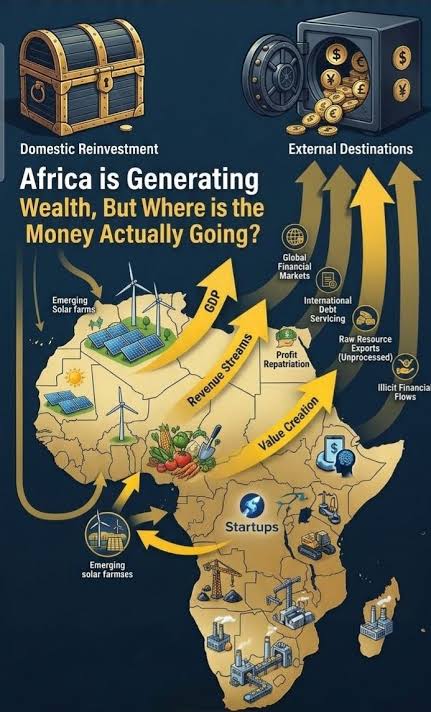
The report's emphasis on productive investment raises broader questions about Africa's ability to finance its own development.
African countries need substantial investment to expand infrastructure, improve productivity and create employment.
However, many governments continue to rely heavily on external financing to meet these needs.
This dependence can expose countries to changes in global financial conditions, including higher interest rates, currency fluctuations and shifts in investor confidence.
When governments have limited access to affordable domestic financing, they may face pressure to borrow from external creditors even when the cost of repayment is high.
The result could be a development model in which economic expansion remains closely tied to the availability of external capital.
If governments are unable to generate sufficient domestic revenue and savings to finance future investment, they may continue borrowing to maintain economic growth.
This raises the possibility that productive investment could improve economic output without fundamentally reducing Africa's dependence on debt.
The report recognises the importance of strengthening domestic financial markets and improving public revenue collection.
However, the broader challenge is ensuring that economic growth translates into greater financial independence rather than simply creating the capacity to service additional borrowing.
What African Governments Need to Consider
The AU–OECD report provides an important argument for improving the quality of public investment.
However, its recommendations also highlight the need for governments to exercise caution when taking on additional debt.
African governments need to ensure that borrowing decisions are based on realistic economic projections and that projects can withstand changes in borrowing costs, exchange rates and demand.
This includes assessing whether projects can generate sufficient direct revenue or wider economic benefits to justify their financing costs.
Governments should also consider alternative sources of financing, including domestic revenue mobilisation, private-sector investment and public-private partnerships where these offer genuine value.
Improving tax collection and reducing financial leakages could help countries expand investment without relying entirely on additional borrowing.
Greater transparency in public procurement and stronger oversight of infrastructure projects would also help reduce the risk of public money being committed to projects that fail to deliver their intended benefits.
For countries already facing serious debt distress, debt restructuring and other financial measures may be necessary alongside productive investment.
The report's findings suggest that reducing investment too aggressively could undermine economic growth and make debt sustainability more difficult to achieve.
However, the opposite approach—borrowing more without adequately managing the risks—could create equally serious problems.
Looking Ahead: Can Productive Investment Break Africa’s Debt Cycle?
The AU and OECD argue that productive investment could help African countries reduce their debt burdens by expanding economic output, creating employment and strengthening government revenue.
The projections suggest that carefully selected investments could deliver substantial economic benefits.
However, the strategy also raises a fundamental question about Africa's development model.
If governments continue relying on borrowing to finance economic growth, will productive investment eventually reduce their dependence on debt, or could it create a cycle in which new borrowing is continually required to sustain development and service existing obligations?
The answer will depend on whether investments generate sufficient returns, whether governments manage borrowing responsibly and whether economic growth translates into stronger public finances.
For African countries already facing high debt repayments, the difference between productive borrowing and unsustainable borrowing may ultimately determine whether the proposed strategy delivers lasting economic transformation.
The continent's challenge is therefore not simply to attract more capital.
It is to ensure that the capital it borrows creates enough economic value to reduce the need for future borrowing.
Without that outcome, productive investment could become another mechanism through which Africa's debt burden is passed from one generation to the next and we definitely don't want that!
Sources: African Union Commission, Organisation for Economic Co-operation and Development, Reuters.
We need to ensure that capital our governments borrow create enough economic value to reduce the need for future borrowing. This is a very serious and important issue we need to address, otherwise, we may pass on the heavy debt burdens to our future generations.
Please complete the verification below to continue.
Please complete the verification
Human verification passed
Edit Comment
Delete Comment
Are you sure you want to delete this comment?
This action cannot be undone.
Loading comment content...
We value your privacy
We use cookies to enhance your browsing experience, serve personalized content, and analyze our traffic. By clicking "Accept All", you consent to our use of cookies. You can manage your preferences at any time. Learn more.
Cookie Settings
We use cookies to improve your experience on our site. You can choose which cookies to allow. Read our full Cookie Policy.
Essential CookiesRequired
These cookies are necessary for the website to function properly and cannot be switched off.
Analytics & Performance
These cookies help us understand how visitors interact with our website by collecting anonymous information.
Functional Cookies
These cookies enable enhanced functionality and personalization, such as remembering your preferences.
Targeting & Advertising
These cookies may be used by advertising partners to build a profile of your interests and show you relevant ads.
















Comments (1)